No products in the cart.
What new myopia research means for your child’s vision
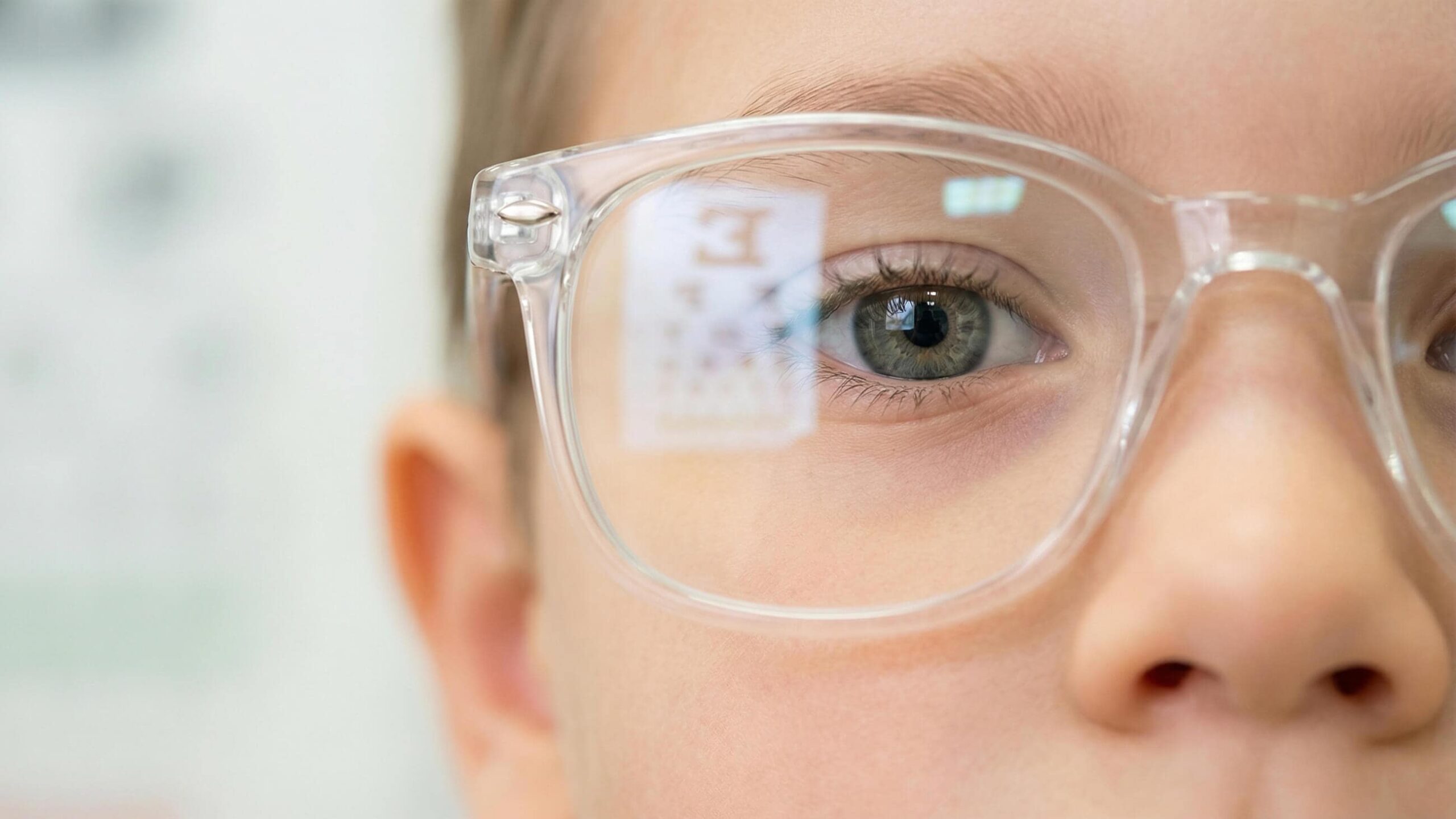
When Sarah brought Emma in for an eye exam, she was prepared to hear that her daughter’s myopia (nearsightedness) had worsened and that she would require a stronger prescription, just as Sarah herself had at that age. Emma had been diagnosed at seven, and now, just 18 months later, her prescription had already changed significantly.
What Sarah did not expect was how much the office visit would challenge her understanding of myopia, a disease she had always considered a mild inconvenience.
Along with a new prescription, the doctor explained the risks of worsening myopia and its potential impact on her daughter’s long-term eye health. Research published over the past several years has shown that progressive myopia in childhood is strongly correlated with a higher occurrence of serious vision conditions later in life, including retinal detachment, glaucoma and myopic maculopathy.
Nearsightedness often develops as the eye gradually gets longer, a physical change that can stretch delicate tissue and increase the risk of serious eye disease decades later. Because of this growing body of research, he told Sarah, eye care providers (ECPs) are changing how they manage myopia.
As he reviewed Emma’s test results, the doctor pointed to the numbers: her prescription, baseline scans, and projected changes over time. The more Emma’s myopia progressed, he explained, the greater her risk of serious eye conditions. That’s why he recommended managing Emma’s vision, as eye doctors had long done, and also working to slow the condition using myopia control strategies.
Sarah left that appointment with a new prescription for glasses, a follow-up scheduled, and a new sense of urgency. Emma’s myopia was no longer just about seeing the classroom more clearly.
While Sarah and Emma are fictitious people, their story is quite relatable
From inconvenience to eye disease
The doctor’s advice reflects an evolving approach toward myopia within the eye care and research communities. What was once considered an optical problem is now viewed by many experts as an active biological process that can cause irreversible structural changes and potentially permanent tissue damage in the eye.
According to the Global Myopia Awareness Coalition (GMAC), which promotes awareness of childhood myopia as a treatable disease, myopia is among the most significant threats to eye health today. Nearly 1 in 3 children worldwide now develops the condition, a rate that has doubled over the past 50 years and continues to rise at an exponential rate.
Myopia prevalence
In September 2024, the National Academies of Sciences, Engineering and Medicine formally recommended that federal health agencies reclassify myopia from a refractive error (a common problem causing blurry vision) to a disease, emphasizing prevention and disease management alongside vision correction.
The recommendation carries significant weight for children and doctors alike. While any degree of myopia increases the risk of vision-threatening complications, that risk rises sharply as myopia progresses.
Yet for many families, this shift has largely gone unnoticed.
A critical disconnect
Despite growing scientific consensus, outreach to families is still underway, so an awareness gap remains. According to 2022 data from the Global Myopia Awareness Coalition, about one-third of parents are unfamiliar with the signs and symptoms of myopia. A similar proportion is unaware that early intervention can help slow myopia’s progression.
This is particularly consequential as myopia prevalence continues to climb. The National Eye Institute (NEI) projects that approximately 44.5 million Americans will have myopia by 2050. Global projections suggest that by that same year, half the world’s population will be nearsighted, with approximately 10% experiencing high myopia severe enough to create substantial, lifelong vat an exponential rateision risk.
East Asia has some of the highest rates. For example, in China, more than half of school-aged children are now myopic, with nearly 1 in 5 high school students experiencing high myopia. Experts suspect that a combination of genetics and environmental factors plays a role in these growing global trends.
Screenings and eye exams are not the same
A misconception among some parents is that vision screenings at pediatricians’ offices or at school are sufficient to detect myopia and other eye-related conditions/diseases. These screenings play an important role, but they are designed as a basic screening check of visual function rather than a full evaluation.
A comprehensive eye exam evaluates the structure and health of the visual system coupled with how the eyes function to work together and focus. It includes measuring visual acuity (sharpness), determining a glasses prescription, eye pressure, retinal assessment, and other diagnostic tests when needed. The exam may also include measuring the length of the eye, a key data point that can help assess myopia risk and monitor progression over time.
Parents do not need to wait for a failed vision screening notice from the school nurse. If a child squints, sits close to screens or books, tilts their head, complains of frequent headaches, or struggles to see distant objects, it’s a good time to schedule a comprehensive eye exam. Early evaluation matters because timing of diagnosis and management can shape long-term outcomes.


SOREN HOWARD
Quam id leo in vitae turpis massa sed in elementum. Do libero justo sit laoreet sed.